

28 September 2026
PRESS RELEASE
Jinggoy backs colleagues’ push to scrap ‘unjust’ system loss charges
WHY should consumers be burdened with charges for electricity that never even reached their homes?
This is the question at the heart of Senate Bill No. 2474, or the proposed “System Loss Charges Abolition Act,” being pushed by Senator Jinggoy Ejercito Estrada, which seeks to permanently scrap the system loss charge — a monthly fee shouldered by consumers for the cost of power lost to technical inefficiencies, poor infrastructure, and even outright pilferage and meter tampering.
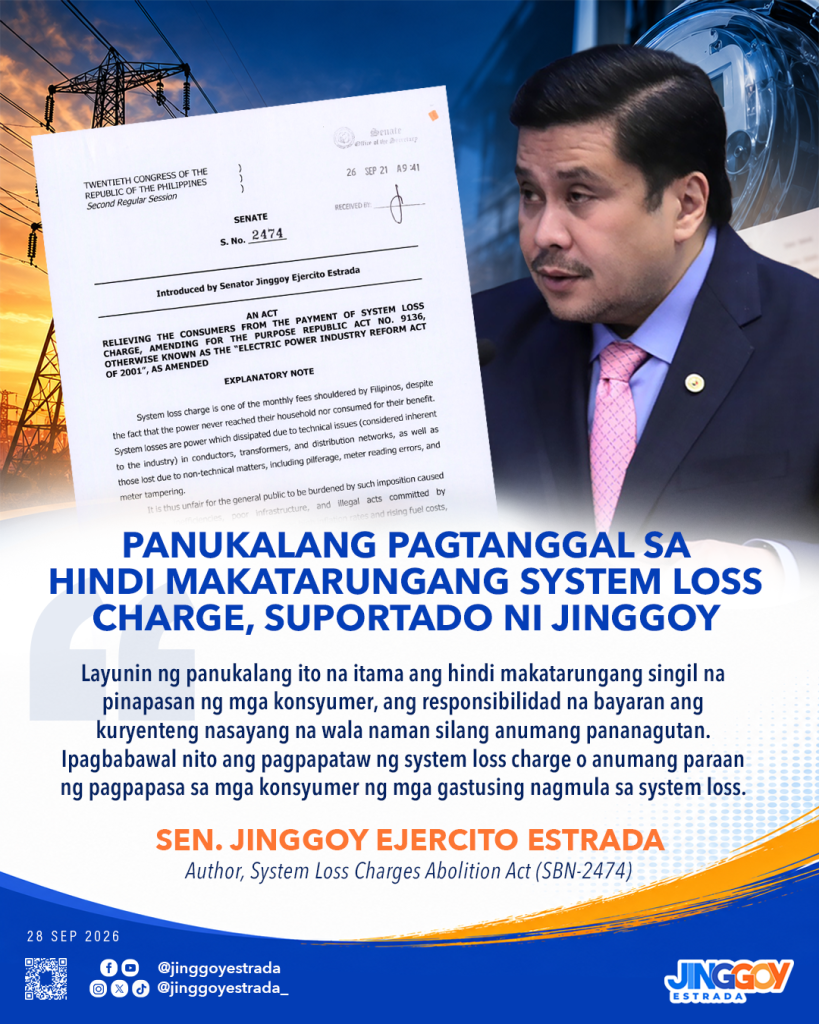
“It is unconscionable, to say the least, to allow this unjust regime to persist any further. Hindi tama na singilin ka sa kuryenteng hindi mo naman nagamit. At lalong hindi tama na sa bulsa ng mga konsyumer ang singil dahil sa kapabayaan sa sistema,” Estrada said.
Estrada is the latest among senators to file a measure seeking to relieve consumers from shouldering the system loss costs incurred by electric providers.
He said the current mechanism, compounded further by value-added tax (VAT), contributes to making domestic power rates among the most expensive in the Southeast Asian region.
“This measure seeks to rectify the ongoing injustice imposed against Filipino consumers who assume the responsibility of paying for electricity lost through no fault of their own. It prohibits the imposition of the system loss charge, or the passing of incurred expenditures related to system loss to their clientele, in any manner or form,” the seasoned lawmaker said.
System losses refer to electricity that dissipates during transmission and distribution — whether through technical issues inherent to conductors, transformers, and distribution networks, or through non-technical causes such as pilferage, meter reading errors, and meter tampering. Under current rules set by the Energy Regulatory Commission (ERC) pursuant to the Electric Power Industry Reform Act of 2001 (EPIRA), these losses are passed on to consumers — up to 5% of the monthly bill for Meralco subscribers, and as high as 12% for those served by electric cooperatives in rural areas.
Estrada’s bill seeks to bar distribution utilities, electric cooperatives, and other regulated entities from passing on, recovering, or charging consumers — directly or indirectly — for any cost attributable to system losses, whether technical or non-technical. These entities would likewise be prohibited from recovering system loss costs incurred even prior to the law’s effectivity, with all such losses to be borne exclusively by the distribution utility or cooperative as a non-recoverable cost for rate-making purposes.
To protect smaller power players and ensure stable supply in the countryside, Estrada’s bill directs the ERC, Department of Energy (DOE), and National Electrification Administration (NEA) to help distribution utilities and electric cooperatives upgrade infrastructure and cut system losses at the source, prioritizing those in geographically isolated areas and those with persistently high losses.
SB 2474 also amends Section 46 of EPIRA to impose escalating penalties on erring utilities. First-time violators face a fine of ₱5 million to ₱10 million, along with full refund of prohibited charges collected from consumers, plus legal interest. Repeat offenders face a steeper fine of ₱10 million to ₱20 million, along with a six-month suspension of their executive officers. For a third offense, the ERC will recommend to Congress the revocation of the entity’s franchise, on top of further fines and criminal liability.
Panukalang pagtanggal sa hindi makatarungang system loss charges, suportado ni Jinggoy
BAKIT kailangang ipasa sa mga konsyumer ang singil sa kuryenteng hindi naman nila napakinabangan?
Ito ang pangunahing punto ng Senate Bill No. 2474 o ang panukalang “System Loss Charges Abolition Act”, na isinusulong ni Senador Jinggoy Ejercito Estrada na layong tuluyan nang alisin sa buwanang singil sa kuryente ang bayarin sa system loss — ang gastos sa kuryenteng nasayang dahil sa technical inefficiencies, mahinang imprastraktura, pagnanakaw at pandaraya sa metro.
“Hindi katanggap-tanggap na magpatuloy pa ang ganitong hindi makatarungang sistema. Hindi tama na singilin ka sa kuryenteng hindi mo naman nagamit. At lalong hindi tama na sa bulsa ng mga konsyumer ang singil dahil sa kapabayaan sa sistema,” sabi ni Estrada.
Si Estrada ang isa sa mga senador na naghain sa Senado ng panukalang batas na naglalayong alisin sa mga konsyumer ang gastos sa pagkawala sa sistema ng mga electric provider na suplay ng kuryente.
Aniya, ang kasalukuyang mekanismo, na pinabigat pa lalo ng pinapataw na value-added tax (VAT), ay isa sa mga dahilan kung bakit itinuturing na pinakamahal sa buong Southeast Asian region.
“Layunin ng panukalang ito na itama ang hindi makatarungang singil na pinapasan ng mga konsyumer, ang responsibilidad na bayaran ang kuryenteng nasayang na wala naman silang anumang pananagutan. Ipagbabawal nito ang pagpapataw ng system loss charge o anumang paraan ng pagpapasa sa mga konsyumer ng mga gastusing nagmula sa system loss,” paliwanag ng beteranong mambabatas.
Ang system loss ay tumutukoy sa kuryenteng nawawala habang ipinapadala at ipinamahagi – maaaring dulot ng mga teknikal na problema sa conductor, transformer at distribution network, maging sa pagnanakaw ng kuryente, maling pagbabasa ng metro at meter tampering.
Sa ilalim ng kasalukuyang tuntunin ng Energy Regulatory Commission (ERC), alinsunod sa Electric Power Industry Reform Act of 2001 (EPIRA), ang halaga ng nawalang kuryenteng ay ipinapasa sa mga konsyumer – na umaabot sa 5% ng buwanang bayarin para sa mga subscriber ng Meralco, at umaabot sa 12% sa mga sakop ng electric cooperatives sa mga lalawigan.
Layunin ng panukalang batas ni Estrada na pagbawalan ang mga distribution utility, electric cooperative, at iba pang regulated entity na ipasa, bawiin o singilin sa mga konsyumer – direkta man o hindi – ang anumang gastos dulot ng system loss, teknikal man ito o hindi.
Pagbabawalan din ang mga ito na bawiin ang gastusing dulot ng system loss na natamo bago pa man magkabisa ang batas. Ang lahat ng ganitong uri ng pagkalugi ay dapat pasanin ng buo ng distribution utility o kooperatiba bilang non-recoverable cost sa pagtatakda ng singil sa kuryente.
Upang maprotektahan ang maliliit na kalahok sa sektor ng kuryente at matiyak ang matatag na suplay sa mga lalawigan, inaatasan ng panukalang batas ni Estrada ang ERC, Department of Energy (DOE), at National Electrification Administration (NEA) na tulungan ang mga distribution utility at electric cooperative na i-upgrade ang imprastruktura at bawasan ang system losses sa pinagmumulan nito, na unang bibigyang-pansin ang mga geographically isolated areas at ang mga may patuloy na mataas na system losses.
Sinususugan din ng SB 2474 ang Section 46 ng EPIRA upang magpatupad ng tumataas na antas ng multa laban sa mga pasaway na utility companies. Ang mga unang beses na lalabag ay haharap sa multang ₱5 milyon hanggang ₱10 milyon, kasama ang buong reimbursement ng mga ipinagbabawal na singil na nakolekta mula sa mga konsumer, kasama ang legal interest. Ang mga paulit-ulit na lumalabag ay haharap sa mas mataas na multang ₱10 milyon hanggang ₱20 milyon, kasama ang anim na buwang suspensyon ng kanilang mga executive officer. Para sa pangatlong paglabag, irerekomenda ng ERC sa Kongreso ang pagbawi ng prangkisa ng entity, kasabay ng karagdagang multa at criminal liability.
-end-