

Beyond the medals
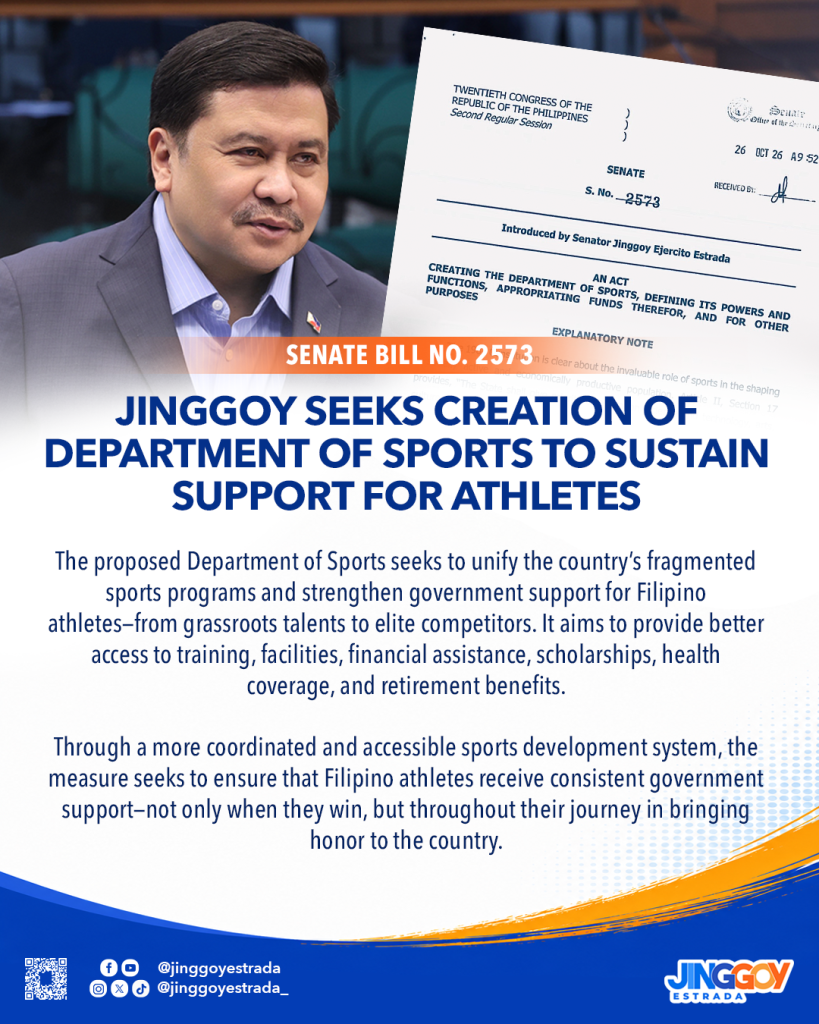
Jinggoy seeks creation of Department of Sports to sustain support for athletes
FRESH off historic international victories that have united the nation, Senator Jinggoy Ejercito Estrada says the creation of a Department of Sports would ensure that Filipino sports heroes receive sustained government backing and no longer have to beg for funding or pay out of their own pockets to represent the country on the world stage.
Estrada said his proposed Senate Bill No. 2573 seeks to oversee the development of Filipino athletes – from grassroots talents in the barangays to elite competitors in the Olympics.
The measure aims to bring the country’s fragmented sports programs under one roof so athletes, coaches, and sports organizations get the necessary attention, resources, and institutional support they need.
“With the historic achievements of our modern-day sports icons like Hidilyn Diaz, Carlos Yulo, EJ Obiena, and Alex Eala on the world stage, and the honor they have brought to the nation, this growing list of international victories underscores the need for a more focused and coordinated approach to developing Filipino sporting talent,” Estrada said.
“Hindi sapat ang palakpak, pagbibigay-parangal, at motorcade para masuklian ang karangalang ibinigay nila sa sambayanang Pilipino. Kailangang maramdaman ng ating mga atleta na nasa likod nila ang gobyerno, hindi lang kapag nananalo sila. Dapat mula sa pagsasanay hanggang sa araw ng laban,” Estrada added.
Under the current setup, various government agencies handle different aspects of sports development, resulting in fragmented programs and the absence of a unified direction.
The veteran lawmaker also pointed out that the lack of sufficient regional presence has made grassroots sports development largely Manila-centric.
Estrada’s proposal seeks to address these gaps by establishing a single department tasked with formulating policies, coordinating programs, developing sports facilities, and overseeing the country’s overall sports development agenda.
The proposed Department of Sports would formulate a unified National Sports Development Agenda covering grassroots programs, elite athlete training, sports science, coaching, and sports facilities. It would also ensure that persons with disabilities, indigenous peoples, and marginalized communities have equal opportunities to participate in sports.
To bring government programs closer to communities outside Metro Manila, the bill provides for a regional office in every region.
The measure would also consolidate the government’s sports-related functions under one agency. The Philippine Sports Commission (PSC) would be abolished, with its functions, funds, and personnel transferred to the new department. Meanwhile, the Games and Amusements Board and the National Academy of Sports would be attached to it.
On sports infrastructure, the department would conduct a nationwide inventory of existing facilities and use the findings to develop a National Sports Infrastructure Master Plan for building, upgrading, and maintaining world-class sports venues.
The bill also provides for cash rewards for historic international victories, as well as scholarships, health coverage, and retirement benefits for athletes.
To safeguard the integrity of sports development programs, the measure requires that their implementation be based on merit and not be used for political patronage or the personal benefit of any public official. It also directs the department to ensure that financial assistance and other support reach athletes, coaches, and sports organizations promptly, without unnecessary bureaucratic delays.
These provisions seek to address long-standing complaints among Filipino athletes, including inadequate support for national teams competing abroad, delayed or insufficient allowances and incentives, and the need to solicit private donations or shoulder training and competition expenses out of pocket.
The bill also respects the autonomy of the Philippine Olympic Committee and national sports associations, which would retain the authority to select the athletes and coaches who will represent the country in international competitions, including the Olympics, Asian Games, and Southeast Asian Games.
The measure also renames the National Sports Development Fund as the ATLETA Fund, to be funded by a share of the proceeds of the Philippine Charity Sweepstakes Office and PAGCOR, taxes on horse races, sports-themed stamps, and duties and taxes on imported athletic equipment. Any shortfall would be covered by annual appropriations from Congress.
To encourage greater private-sector participation, donations to the department would be tax-deductible and exempt from donor’s tax. Certain imported sports equipment not available locally would be exempt from customs duties, and national delegations participating in international competitions would be exempt from travel and airport taxes.
“Our athletes have shown that Filipino talent can compete with the best in the world. It is now our responsibility to build a system that will help them reach their full potential and give the next generation of athletes the same opportunities to bring honor to our country,” Estrada said.
Department of Sports, isinusulong ni Jinggoy para sa mga atleta
Kasunod ng mga makasaysayang tagumpay ng mga atletang Pilipino sa ibang bansa, isinusulong ngayon ang panukalang titiyak sa tuloy-tuloy na suporta ng pamahalaan sa kanila, mula sa pagsasanay hanggang sa pagrepresenta sa bansa sa pandaigdigang entablado.
Sa panukala ni Senador Jinggoy Ejercito Estrada, bubuo ng Department of Sports na tututok sa paghasa ng husay ng mga atletang Pilipino, mula sa mga batang talento sa barangay hanggang sa mga lalaban sa Olympics. Pagsasamahin nito sa iisang tanggapan ang watak-watak na mga programang pampalakasan para makuha ng mga atleta, coach, at organisasyon ang atensyon, pondo, at suportang kailangan nila.
“Dahil sa mga makasaysayang tagumpay nina Hidilyn Diaz, Carlos Yulo, EJ Obiena, at Alex Eala sa pandaigdigang entablado, malinaw na kailangan natin ng mas nakatuon at maayos na pamamaraan sa paghubog ng talentong Pilipino sa palakasan,” ani Estrada nang ihain ang Senate Bill No. 2573.
“Hindi sapat ang palakpak, pagbibigay-parangal, at motorcade para masuklian ang karangalang ibinigay nila sa sambayanang Pilipino. Kailangang maramdaman ng ating mga atleta na nasa likod nila ang gobyerno, hindi lang kapag nananalo sila. Dapat mula sa pagsasanay hanggang sa araw ng laban,” dagdag ni Estrada.
Sa kasalukuyan, iba’t ibang ahensya ang may hawak sa iba’t ibang bahagi ng palakasan, kaya watak-watak ang mga programa at walang iisang direksyon. Dahil kulang din ang presensya ng mga ito sa mga rehiyon, halos nakasentro lang sa Maynila ang grassroots sports, ayon sa beteranong mambabatas.
Sa ilalim ng panukala, ang departamento ang gagawa ng mga patakaran, mag-uugnay ng mga programa, magpapaunlad ng mga pasilidad, at mangangasiwa sa kabuuang adyenda ng bansa sa palakasan.
Bubuo ito ng National Sports Development Agenda na sasaklaw sa grassroots programs, pagsasanay ng mga elite na atleta, sports science, pagko-coach, at mga pasilidad. Titiyakin din nitong pantay ang pagkakataon ng mga person with disability, katutubo, at mga marhinalisadong komunidad na makalahok sa palakasan. Para mailapit ang mga programa sa mga komunidad sa labas ng Metro Manila, magtatayo ng tanggapan sa bawat rehiyon.
Buwag na rin ang Philippine Sports Commission (PSC), at ililipat sa bagong departamento ang mga tungkulin, pondo, at tauhan nito. Mapapasailalim naman sa departamento ang Games and Amusements Board at ang National Academy of Sports.
Magsasagawa rin ang departamento ng pambansang imbentaryo ng mga pasilidad na gagamitin sa pagbuo ng National Sports Infrastructure Master Plan para sa pagtatayo, pag-upgrade, at pagpapanatili ng mga world-class na venue.
Nakasaad din sa panukala ang cash reward para sa mga makasaysayang panalo sa pandaigdigang kompetisyon, pati na ang scholarship, health coverage, at retirement benefits para sa mga atleta.
Para matiyak na patas ang pagpapatupad, dapat nakabatay sa merito ang mga programa at ipinagbabawal na gamitin ang mga ito sa pamumulitika o sa pansariling pakinabang ng sinumang opisyal. Inaatasan din ang departamento na tiyaking mabilis na makararating ang tulong pinansyal at iba pang suporta sa mga atleta, coach, at organisasyon, nang walang pagkaantala dahil sa burukrasya.
Layunin ng mga probisyong ito na tugunan ang matagal nang hinaing ng mga atleta: kulang na suporta sa mga pambansang koponang lumalaban sa ibang bansa, naantalang allowance at insentibo, at ang pangangailangang manghingi ng donasyon o gumastos mula sa sariling bulsa para sa pagsasanay at mga laban.
Iginagalang din ng panukala ang awtonomiya ng Philippine Olympic Committee at ng mga pambansang asosasyong pampalakasan. Sila pa rin ang pipili ng mga atleta at coach na kakatawan sa bansa sa mga pandaigdigang kompetisyon, kabilang ang Olympics, Asian Games, at Southeast Asian Games.
Papalitan ng pangalan ang National Sports Development Fund at gagawing ATLETA Fund. Popondohan ito ng bahagi ng kita ng Philippine Charity Sweepstakes Office at PAGCOR, buwis sa karera ng kabayo, mga selyong may temang pampalakasan, at mga duty at buwis sa inaangkat na kagamitang pang-atleta. Kung may kulang pa, sasagutin ito ng taunang pondo mula sa Kongreso.
Para mahikayat ang pribadong sektor na tumulong, tax-deductible at hindi papatawan ng donor’s tax ang mga donasyon sa departamento. Hindi rin papatawan ng customs duties ang ilang inaangkat na kagamitang pampalakasan na hindi makukuha sa bansa, at exempted din sa buwis sa biyahe at paliparan ang mga pambansang delegasyong lalahok sa mga pandaigdigang kompetisyon.
“Ipinakita ng ating mga atleta na kayang makipagsabayan ng talentong Pilipino sa pinakamahusay sa mundo. Responsibilidad na natin ngayon na bumuo ng sistemang tutulong sa kanila na maabot ang kanilang buong potensyal at magbibigay sa susunod na henerasyon ng mga atleta ng parehong oportunidad na magbigay-karangalan sa ating bansa,” ani Estrada.