

SENATOR Jinggoy Ejercito Estrada has filed a bill seeking to make voting more accessible for Filipinos in vulnerable situations, such as senior citizens, persons with disabilities (PWDs), pregnant women, internally displaced persons (IDPs), health workers on duty, and even repatriated overseas workers, by expanding local absentee voting and improving polling facilities nationwide.
Filed as Senate Bill No. 1075, the measure provides alternative modes of voting for persons in vulnerable situations, allowing them to cast their ballots ahead of Election Day, or in specially designated accessible venues.
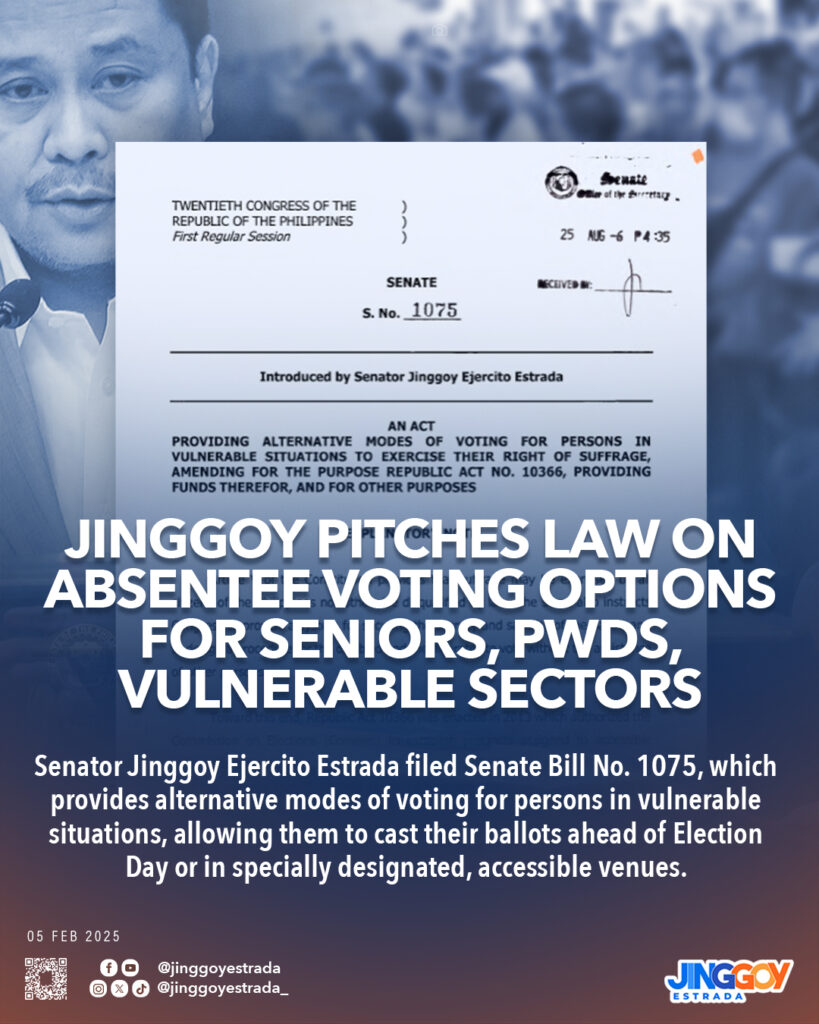
“Karapatan ng bawat Filipino, maliban na lamang kung diskwalipikado ng batas, ang bumoto. Hindi nawawala ang karapatang ito dahil sa kahinaan ng katawan, edad, o sitwasyon sa buhay,” Estrada said.
He said that while Republic Act No. 10366 already authorizes the Commission on Elections (Comelec) to establish accessible polling places exclusively for senior citizens and PWDs, many voters from vulnerable sectors have remained disenfranchised.
He noted that during the 2019 elections, only about three percent of the nearly eight million registered senior citizen voters were able to cast their ballots, highlighting serious gaps in accessibility.
“The unfortunate low turnout underscores the urgency of strengthening the law to truly ensure accessible polling places,” he stressed.
Data from the Convention on Statistics organized by the Philippine Statistical System and spearheaded by the Philippine Statistics Authority in October 2022 show that there are more than 10.2 million registered voters aged 60 years and above, comprising the majority of voters considered to be in vulnerable situations.
Under SB 1075, qualified voters from vulnerable sectors may avail of local absentee voting for at least two days within the week prior to Election Day, which shall be held in accessible establishments designated by the Comelec. The bill also authorizes the establishment of Emergency Accessible Polling Places in residences, hospitals, quarantine facilities, jails, IDP areas, and other locations where voters may find it difficult to go to regular polling centers.
The proposed bill further sets clearer and more comprehensive standards for accessible polling places, including the installation of ramps and railings, availability of wheelchairs, adequate lighting and ventilation, lists of candidates in Braille, and the presence of sign language interpreters. It also provides for transportation or shuttle services to help vulnerable voters reach polling sites.
To ensure effective implementation, the bill authorizes the creation of a Vulnerable Sectors Office within the Comelec, which shall oversee programs and services for these groups.
“This is about dignity and equal participation. Voting is a right, not a privilege,” Estrada said. “No Filipino should be denied a voice in choosing our leaders simply because voting was made physically or logistically difficult for them.”
Jinggoy isinusulong ang batas sa absentee voting para sa seniors, PWDs at ibang nasa vulnerable sectors
ISINUSULONG ni Senador Jinggoy Ejercito Estrada ang pagpasa ng batas na naglalayong gawing mas madali ang pagboto para sa mga tinaguriang vulnerable sector na kinabibilangan ng mga senior citizen, persons with disabilities (PWDs), buntis, internally displaced persons (IDPs), health workers na naka-duty, maging ang mga repatriated overseas workers sa pamamagitan ng pagpapalawak ng local absentee voting at pagpapabuti ng mga pasilidad ng botohan para sa kanila sa buong bansa.
Sa kanyang Senate Bill No. 1075, ipinapanukala ni Estrada ang pagbibigay ng alternatibong paraan ng pagboto para sa mga nabibilang sa nasabing sektor at ang pagpapahintulot sa kanila na bumoto bago pa ang takdang araw ng halalan sa mga itinalagang espesyal na lugar.
“Karapatan ng bawat Pilipino, maliban na lamang kung sila ay diskwalipikado, ang bumoto. Hindi nawawala ang karapatang ito dahil sa kahinaan ng katawan, edad, o sitwasyon sa buhay,” pahayag ni Estrada.
Bagama’t umiiral na ang Republic Act No. 10366 na nagbibigay kapangyarihan sa Commission on Elections (Comelec) na magtatag ng mga accessible polling places para sa mga senior citizens at PWDs, sinabi ni Estrada na marami pa ring botante mula sa mga vulnerable sector ang hindi nakaboboto.
Binanggit niya na noong 2019 elections, humigit-kumulang tatlong porsiyento lamang ng halos walong milyong rehistradong senior citizen voters ang nakaboto, na aniya ay nagpapakita ng malalaking kakulangan sa accessibility ng ating sistema ng halalan.
“Ang mababang turnout na ito ay malinaw na nagpapakita ng agarang pangangailangan na palakasin ang batas upang tunay na masiguro ang pagkakaroon ng accessible na mga polling places,” diin ng senador.
Batay sa datos mula sa Convention on Statistics na inorganisa ng Philippine Statistical System sa pangunguna ng Philippine Statistics Authority noong Oktubre 2022, mahigit 10.2 milyong rehistradong botante na may edad 60 pataas ang naitala, na bumubuo sa malaking bahagi ng mga botanteng itinuturing na nasa vulnerable situation.
Sa ilalim ng SB 1075, maaaring mag-avail ang mga kwalipikadong botante mula sa mga vulnerable sector ng local absentee voting dalawang araw bago ang takdang araw ng halalan, na gagawin sa mga accessible na establisimyentong itatalaga ng Comelec. Pinapahintulutan din ng panukalang batas ang pagtatatag ng Emergency Accessible Polling Places sa mga tirahan, ospital, quarantine facilities, kulungan, mga lugar ng IDPs, at sa iba pang lugar kung saan maaaring mahirapan ang mga botante na pumunta sa mga regular na polling center.
Itinatakda rin ng panukalang batas ang mas malinaw at mas komprehensibong pamantayan para sa accessible polling places, kabilang na ang pagkakaroon ng mga rampa at handrail, wheelchair, sapat na ilaw at bentilasyon, listahan ng mga kandidato na nasa Braille, at presensya ng mga sign language interpreter. Mayroon din itong probisyon para sa transportasyon o shuttle service upang matulungan ang mga nasabing botante na makarating sa mga polling sites.
Upang matiyak ang maayos na pagpapatupad ng panukala, pinahihintulutan nito ang paglikha ng isang Vulnerable Sectors Office sa loob ng Comelec na mangangasiwa sa mga programa at serbisyong nakalaan para sa mga grupong ito.
“Ito ay usapin ng dignidad at pantay na pakikilahok. Ang pagboto ay isang karapatan, hindi pribilehiyo,” ani Estrada. “Walang Filipino ang dapat pagbawalan na magkaroon ng boses sa pagpili ng ating mga lider dahil lamang sa pisikal o lohistikal na kahirapan sa pagboto.”