

CO-SPONSORSHIP SPEECH
An Act Establishing the Classroom-Building Acceleration Program (CAP) Under the Department of Education, Authorizing Local Government Units and Civil Society Organizations to Undertake Classroom Construction Projects
“Classroom-Building Acceleration Program (CAP) Act”
Senate Bill No. 1482 under Committee Report No. 6
Senator Jinggoy Ejercito Estrada
November 11, 2025
Mr. President, we have always considered the schools as the “second home” of our children, as they spend most of their waking hours there, being molded by their teachers who stand as their “second parents” to be responsible and productive citizens of our country. To enable the students to reach their full potential in learning and honing their skills, and to allow our educators to effectively conduct their classes, we have long acknowledged the need to provide safe and secure classrooms.
Sadly, despite these long-acknowledged facts, the lack of classrooms and the deplorable state of the existing ones have been persistent problems in our basic education system. Based on the enrolment and inventory for School Year 2022-2023, the top three (3) regions with classroom shortage are:
- Region IV-A (Calabarzon) which needs 31,002 classrooms;
- National Capital Region (NCR) which needs 24,874 classrooms; and
- The Bangsamoro Autonomous Region in Muslim Mindanao (BARMM) which needs 13,237 classrooms.
I cannot overemphasize the findings of the Second Congressional Commission on Education (EDCOM II) in their Year Two Report which was quoted several times in these halls, stating that in 2023, “the backlog in classroom construction is at 165,000 classrooms, with many schools resorting to multiple shifts as well as alternative delivery modes. Regional disparities exist between urban and rural areas, with the former facing congestion due to high population density. Likewise, only 30% of school buildings are in good condition.” As of October 2025, the Department of Education or DepEd reported that there are 146,708 classroom backlogs all over the country.[1]
The government has been initiating various programs to address this problem:
- The Public-Private Partnership (PPP) for School Infrastructure Program or PSIP, which is being implemented in phases since 2013, will be running until 2031.
- The DepEd also piloted this year the leasing of unused private buildings, particularly in private schools that have closed down, to convert them into classrooms.
- Recently, the administration announced that the DepEd, the Department of Public Works and Highways, and the local government units will be working together to build more than 2,000 classrooms until 2026. This is in line with the target to build 40,000 classrooms by 2028.[2]
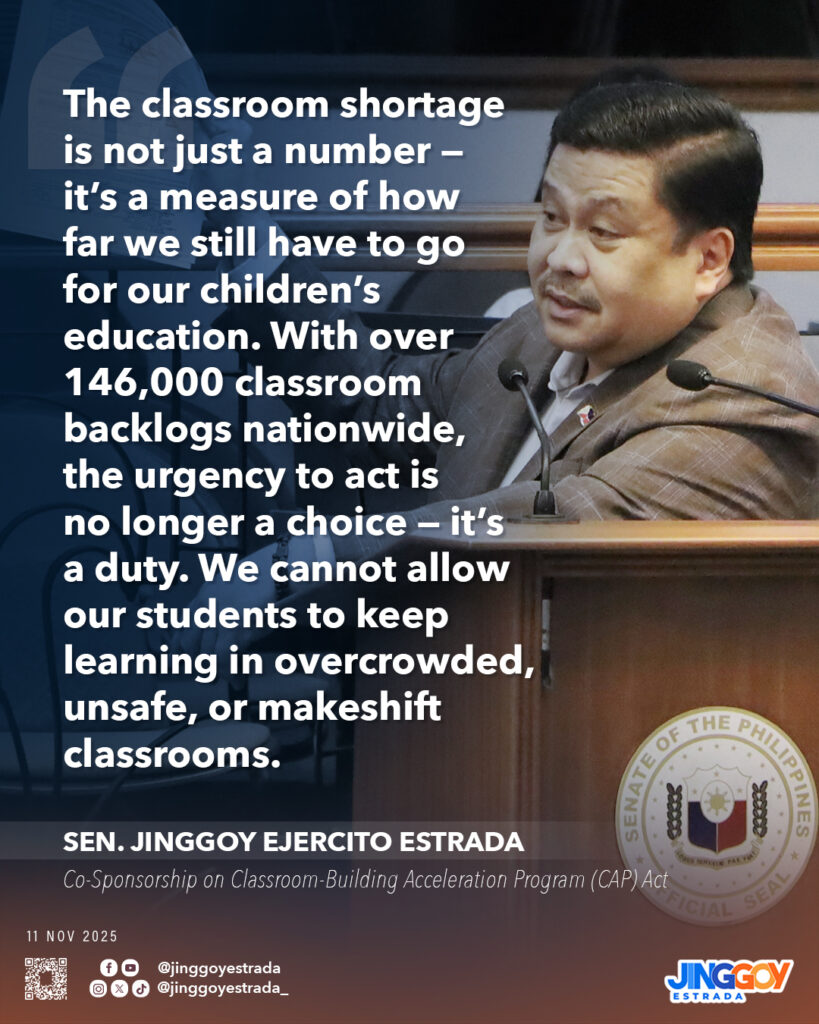
However, various challenges constantly hamper the achievement of our targets. PSIP I, for instance, experienced delays because of the delay in the Independent Consultant procurement, project site issues, and delay in the issuance of required permits by local government units.[3] PSIP II were called out by the Commission on Audit as having delayed completion of projects attributed to accessibility issues in the project site and force majeure.[4] At present, the Department of Public Works and Highways constructed on twenty-two (22) classrooms for the year 2025 out of the 1,700 target.[5]
If the government will continue to allocate measly P24 billion annually to construct classroom buildings under the current prices and system, it was estimated that it will take twenty (20) years to finally close the gap.[6]
The immensity of the need and necessity for continuous monitoring and provision of sufficient number of classrooms call for a legal framework that will ensure reliable guidelines and funding across the years and beyond political administrations, until the classroom backlog in the country is fully resolved.
This is the objective of the “Classroom-Building Acceleration Program (CAP) Act”, reported out by the Committee on Basic Education as Senate Bill No. 1482 under Committee Report No. 6.
The proposed measure is founded on the strength of collaboration among the prime movers in education namely – the Department of Education, the local government units and the civil society organizations. Ang kagalingan ng bayanihan at pagtutulungan ay siyang batayan ng panukalang batas na ito. Ang sama-samang pagkilos upang mabigyan ng maayos, ligtas at sapat na mga silid-aralan ang ating mga mag-aaral ang isa sa pinakamabisang solusyon upang agarang tugunan ang matagal na nating suliranin.
With the permission of the good Sponsor, Senator Bam Aquino, I wish to be one of the co-sponsors of the measure. I believe that this will complement all the efforts being undertaken by the Department of Education and its partner agencies. By providing the standards, identifying the funding and cost ceiling, and ensuring transparency, accountability, monitoring and review, the bill assures that every cent for building a classroom is responsibly spent for its intended purpose.
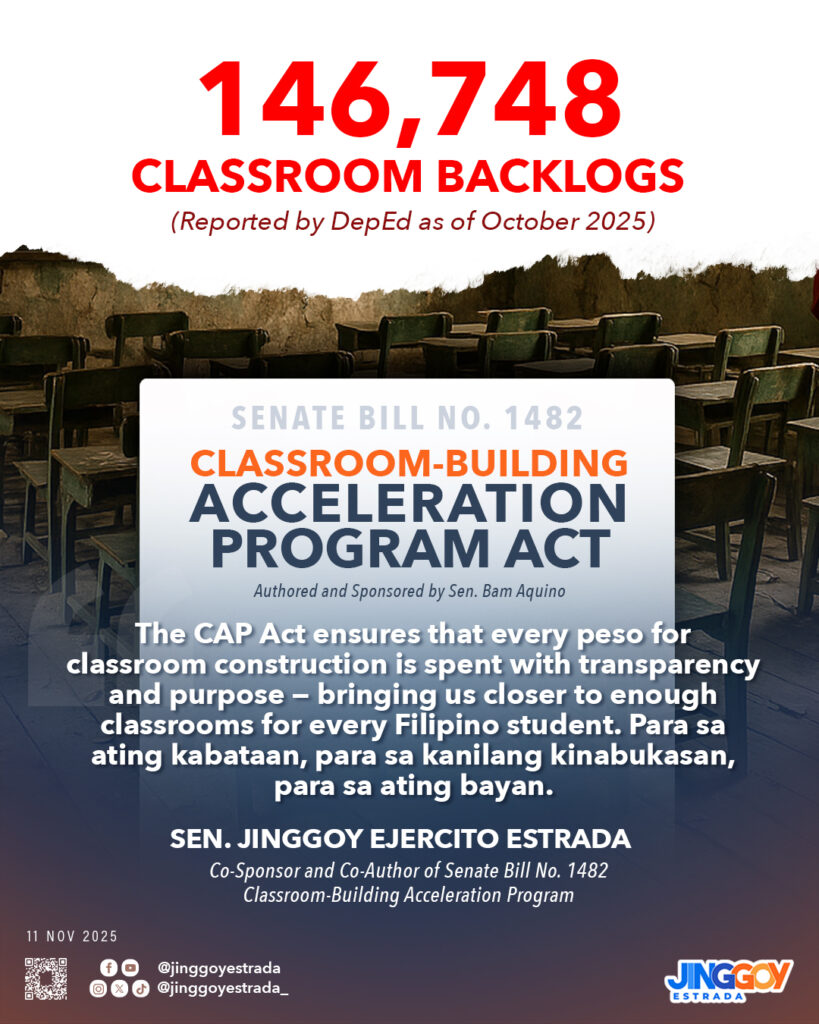
We are optimistic that this piece of legislation will finally end our chase for sufficient number of classrooms for our students and ultimately achieve our ideal classroom-to-student ratio – para sa ating kabataan, para sa kanilang kinabukasan, para sa ating bayan.
We urge our colleagues to support the immediate passage of this measure.
Thank you, Mr. President.
[1] DepEd chief pushes classroom building reform to tackle shortage | Philippine News Agency
[2] DepEd, DPWH, LGUs to join forces in building over 2000 classrooms until 2026: Palace | ABS-CBN News
[3] KMD_20201203_PUBMAT_PSIP-Project-Briefer-CTP
[4] COA flags setbacks in DepEd’s P20-billion classroom PPP project | Inquirer News
[5] DepEd, DPWH, LGUs to join forces in building over 2000 classrooms until 2026: Palace | ABS-CBN News
[6] Classroom shortage in the Philippines hits young students the hardest